What is LEGO® SERIOUS PLAY® and how a workshop works
“Playing with LEGO in a meeting?” It is the most common reaction when people first hear about LEGO® SERIOUS PLAY®. Then, ten minutes into a workshop, the same person is telling the group what they really think about their own project, using a model built with their hands.
It is no accident, and it is not just a fondness for bricks. The method rests on well-studied mechanisms of how our brain reacts to social situations, learns and remembers. In this article we look at what LEGO® SERIOUS PLAY® is, which scientific foundations explain why it works, and how a workshop unfolds in practice.
What LEGO® SERIOUS PLAY® is
A facilitation method in which each participant answers a question by building a model out of bricks, tells the group about it and relates it to everyone else’s. The principle is simple: thinking with your hands.
Facilitates creative thinking
Both individual and group: everyone develops their own ideas before comparing them with others.
Promotes authentic communication
You speak through the model: it is easier to say what you really think, even uncomfortable things.
Solves complex problems
Through visual models, first individual and then shared, which make abstract concepts tangible.
The science behind the method
1. The brain and social threats: the SCARF model
Faced with something new or unknown, the brain reacts in one of two ways: it moves away, perceiving a threat, or it moves towards, perceiving a reward. The neuroscientist David Rock, co-founder of the NeuroLeadership Institute, summarised in the SCARF model the five social domains that trigger this reaction: Status, Certainty, Autonomy, Relatedness and Fairness.
When one of these domains is threatened, for example by criticism in front of everyone, unclear goals or a boss who decides alone, the mind becomes defensive and creativity and collaboration collapse. A traditional meeting, without meaning to, often threatens more than one of them. A LEGO® SERIOUS PLAY® workshop is built to do the opposite.
How the method answers the five SCARF domains
Status
The model is discussed, never the person: no one is put on the spot in front of the group.
Certainty
The process is clear and always the same: question, building, sharing, reflection.
Autonomy
Everyone builds their own answer: there is no right way, there is your way.
Relatedness
The stories behind the models create authentic connections, beyond roles and hierarchies.
Fairness
Everyone builds and everyone speaks, with the same time and the same space.
2. Emotions and learning: the state of flow
The psychologist Mihály Csíkszentmihályi described flow as the state in which we are fully focused and absorbed in what we are doing. It is reached when the challenge is proportionate to our skills: if the challenge far exceeds our abilities, anxiety arises; if our abilities far exceed the challenge, boredom sets in.
A LEGO® SERIOUS PLAY® workshop is designed to keep participants in this channel. The initial warm-up exercises, the skills building, quickly raise everyone’s competence in building and storytelling. The questions then become progressively deeper, so that the challenge grows together with the group’s abilities.
Challenge and competence
- High challenge, low competence: anxiety.
- Low challenge, high competence: boredom.
- Challenge and competence growing together: flow, effective learning and well-being.
3. Why we remember what we build
Research on memory and learning converges on two conditions for information to be stored long term: it must connect to knowledge we already have and it must engage the emotional system. Tse and colleagues (Science, 2007) show that new information is consolidated much faster when it fits into an existing framework of knowledge. Cahill and McGaugh (Trends in Neurosciences, 1998) described how emotional arousal strengthens memory. Immordino-Yang and Damasio (Mind, Brain, and Education, 2007) showed that emotion and reasoning are intertwined in every form of learning.
In a workshop every model comes from the builder’s own experience, so it starts from what the person already knows. And telling the story in front of the group is emotionally engaging. That is why, months later, participants still remember their model and the decisions made.
4. Play: a skill we all already have
If there is one skill every person in the group already has, it is play. And it is older than our species. Play behaviour has been observed in mammals, birds, some reptiles and even some fish, a sign of very deep evolutionary origins (Burghardt, 2005). Rats emit ultrasonic vocalisations similar to laughter when tickled and actively seek out play partners. Crows have been seen playing in the snow with no apparent purpose other than fun (Pellis & Pellis, 2009).
Play, in short, is one of the most universal forms of intelligence there is. LEGO® SERIOUS PLAY® does not ask participants to learn something new in order to communicate: it uses a language they have always known, and for that reason it lowers defences and shortens distances.
How a workshop works
- Designing backwards. The workshop is designed starting from the problem and the expected result, tailored to the team’s specific challenge.
- The question. The facilitator poses a precise challenge, for example: “Build how you see your team today”.
- Building. Everyone builds a model that answers the question. What counts is the meaning of each piece, not the aesthetics.
- Sharing. In turn, each participant tells their answer through the model.
- Reflection. The group asks questions about the models to internalise what has emerged and give a solid basis to the shared story.
The cycle repeats with ever deeper questions: from individual models to the shared model, up to relationship maps, scenarios or guiding principles that the team will take into daily work.
The rules of serious play
- No judgement: we talk about the model, not the person.
- Contribute at your best: every voice counts.
- Trust the process: results emerge step by step.
- Bonus: have fun, seriously.
A real example
With a data-centre Safety Committee the goal was to make safety something alive and practicable every day. In a few hours the committee built a shared vision and defined the year’s priorities: a safety culture based on data and feedback, leading by example, clearer internal communication. Abstract concepts became models everyone could see and discuss.
It integrates with other methods
LEGO® SERIOUS PLAY® is a complete method, but it can be combined with other facilitation tools, as long as its methodology and flow are respected. A good companion is Liberating Structures by Henri Lipmanowicz and Keith McCandless, useful for widening participation in opening or summing-up phases.
Frequently asked questions
Do I need to be good at building?
No. The initial warm-up brings everyone to the same level in a few minutes, and the value of a model lies in the story it tells.
How long does a workshop last?
It depends on the goal: from a few hours to align a team on a theme, to a full day to work on vision and strategy.
Is a facilitator needed?
Yes. The facilitator designs the questions starting from the problem, guides the build-share-reflect cycle and makes sure every voice has the same space. It is what turns a playful activity into work with concrete results.
In which contexts is it used?
In corporate team building, in vision and strategy workshops, in educational contexts with teachers and parents, and wherever everyone’s point of view needs to emerge.
Sources
- Rock, D. (2008). SCARF: a brain-based model for collaborating with and influencing others. NeuroLeadership Journal.
- Csíkszentmihályi, M. (1990). Flow: The Psychology of Optimal Experience.
- Tse, D. et al. (2007). Schemas and memory consolidation. Science.
- Cahill, L. & McGaugh, J. L. (1998). Mechanisms of emotional arousal and lasting declarative memory. Trends in Neurosciences.
- Immordino-Yang, M. H. & Damasio, A. (2007). We feel, therefore we learn. Mind, Brain, and Education.
- Burghardt, G. M. (2005). The Genesis of Animal Play.
- Pellis, S. & Pellis, V. (2009). The Playful Brain.
Written by
Samuele Granata
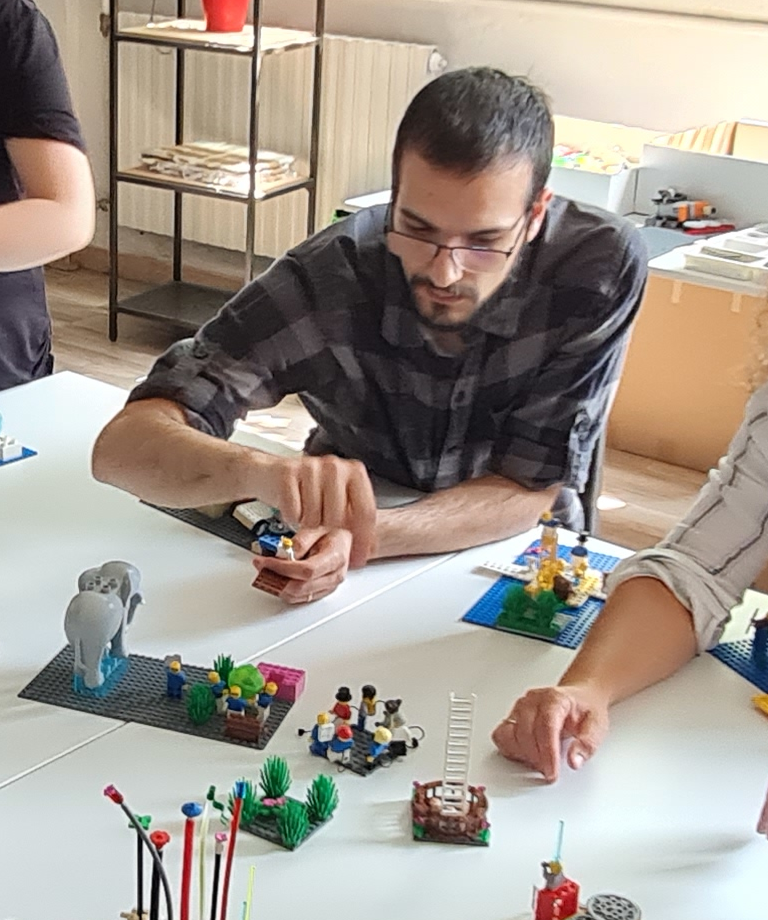
Certified LEGO® SERIOUS PLAY® facilitator and founder of IPPOPO. With over 10 years of experience in IT, he designs team-building workshops and games for companies, events and schools in Milan and Lombardy. About me →
Want to try the method with your team?
IPPOPO designs and facilitates LEGO® SERIOUS PLAY® workshops in Milan, in Lombardy and at your premises.