Corporate team building in Milan: how to choose one that leaves something behind
In Milan the choice of team building is huge: cooking classes, escape rooms, regattas, treasure hunts in the city centre. Many are pleasant experiences. The problem is that, the following Monday, the team often goes back to exactly how it was.
An effective team building is not measured by how much fun people had, but by what is left: stronger relationships, a common language, clearer goals. In this guide we look at how to choose the right activity, which questions to ask whoever proposes it, and when an approach like LEGO® SERIOUS PLAY® makes sense.
The four criteria for choosing
1. A clear goal
Cohesion, alignment on a project, integrating new colleagues, managing change: each goal calls for a different activity. “Building a team” is not enough as a brief.
2. Everyone really takes part
In competitive or physical activities the same people always stand out. Choose a format where even the most reserved have room, without feeling exposed.
3. A result to take home
Guiding principles, shared priorities, agreements on how to work together: something concrete the team can pick up again in the following weeks.
4. A facilitator, not an entertainer
Whoever leads must be able to design the activity around your goal and manage group dynamics, not just enforce the rules of a game.
Why some team buildings leave their mark and others don’t
Research on memory and learning points to two conditions for an experience to be stored long term: it must connect to what we already know and it must engage us emotionally. A fun activity disconnected from work satisfies the second condition and misses the first: people enjoy themselves, but the link with the life of the team is weak.
The climate matters too. According to neuroscientist David Rock’s SCARF model, the brain reacts as if to a threat when status, certainty, autonomy, relationships or fairness feel at stake. An activity in which someone feels judged or overshadowed produces the opposite of the intended effect. We explored these mechanisms in What is LEGO® SERIOUS PLAY® and how a workshop works.
5 questions to ask the provider
- How do you adapt the activity to our goal?
- How do you make sure everyone takes part, not just the extroverts?
- What will we have in hand at the end of the day?
- Who leads it and what training do they have?
- What happens next: is there a debrief or follow-up?
Traditional team building and LEGO® SERIOUS PLAY® compared
Recreational activity
- Main goal: fun and socialising.
- Participation often skewed towards the most extroverted or sporty.
- The link with daily work stays implicit.
- Great for celebrating, less so for aligning.
LEGO® SERIOUS PLAY® workshop
- Goal designed to measure: cohesion, vision, guiding principles.
- Everyone builds and everyone speaks, with the same space.
- The models are about your team and your work.
- It ends with concrete, photographed outputs to come back to over time.
The two do not exclude each other: a workshop in the morning and a convivial activity in the afternoon is a combination that works very well.
Two real examples
A large event. At the BNI Italy National Conference around a hundred executives and area directors took part in a team-building activity based on serious play, co-led with UPAYA. The keyword of the day was “together”: laughing, working hard and collaborating in the same experience, strengthening ties between people who work in different cities.
A sales department. With the Tec Italia sales team the workshop worked on shared goals and perspectives. The result, in the participants’ words: more clarity on goals, more connection between people, more energy for the challenges ahead.
“Thanks to IPPOPO, our sales department broadened its perspective and has been able to offer our clients new, successful solutions.”
Marco Maraschi, CEO and Founder, Tec Italia s.r.l.
For formats, durations and arrangements, see the page on corporate team building in Milan.
Written by
Samuele Granata
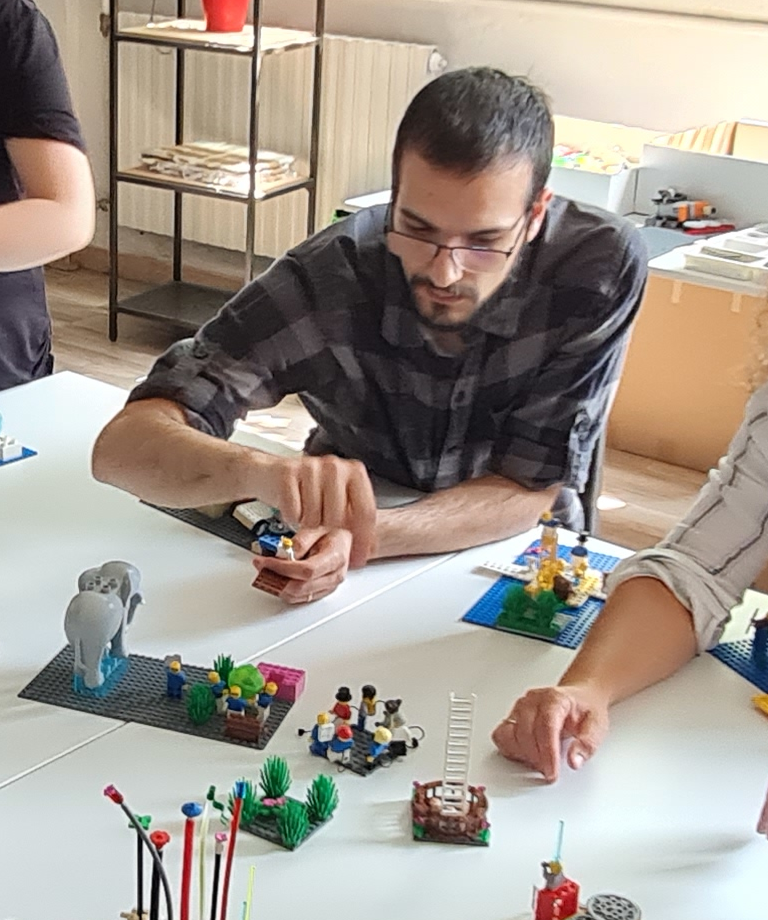
Certified LEGO® SERIOUS PLAY® facilitator and founder of IPPOPO. With over 10 years of experience in IT, he designs team-building workshops and games for companies, events and schools in Milan and Lombardy. About me →
Planning a team building?
Tell us about your team and your goal: we will design a workshop that leaves something behind.