Safety culture: building a shared vision through serious play
Every organisation has safety procedures. Far fewer have a real safety culture: one in which people report a near miss without fear, stop when something does not add up, and feel responsible for their colleagues’ safety too.
The gap between the two is not closed with another procedure or another slide. People need to share a vision of what “working safely” means, and feel it is their own. This is where a method like LEGO® SERIOUS PLAY® can make the difference.
Why procedures alone are not enough
A safety report is, first of all, a social act: it means admitting a mistake, contradicting a more experienced colleague or stopping an urgent job. Researcher Amy Edmondson (Harvard Business School) showed in her studies of work teams, starting in 1999, that people speak openly about errors and problems only where there is psychological safety: the shared belief that speaking up will not have negative consequences.
David Rock’s SCARF model explains the mechanism: when people perceive a threat to their status or to the certainty of their position, the brain goes on the defensive. And that is exactly when a near miss goes unreported. Building a safety culture therefore means working on these relational aspects, not only on rules and controls.
How LEGO® SERIOUS PLAY® helps
Makes the abstract concrete
“Culture”, “responsibility”, “trust” become models on the table that everyone can see, point to and discuss.
Creates a safe space
The model is discussed, not the person. It is easier to name barriers, biases and problems that usually go unsaid.
Every voice counts
The field technician and the manager build and speak with the same space: viewpoints emerge that hierarchies usually filter out.
The vision belongs to everyone
Goals come from the participants’ words, not from a document handed down from above. And what you build together, you remember and defend.
A real case: the Safety Committee of a data centre
A safety committee wanted three things: to align on common goals, to build a shared vision and to make safety something alive, concrete and practicable every day.
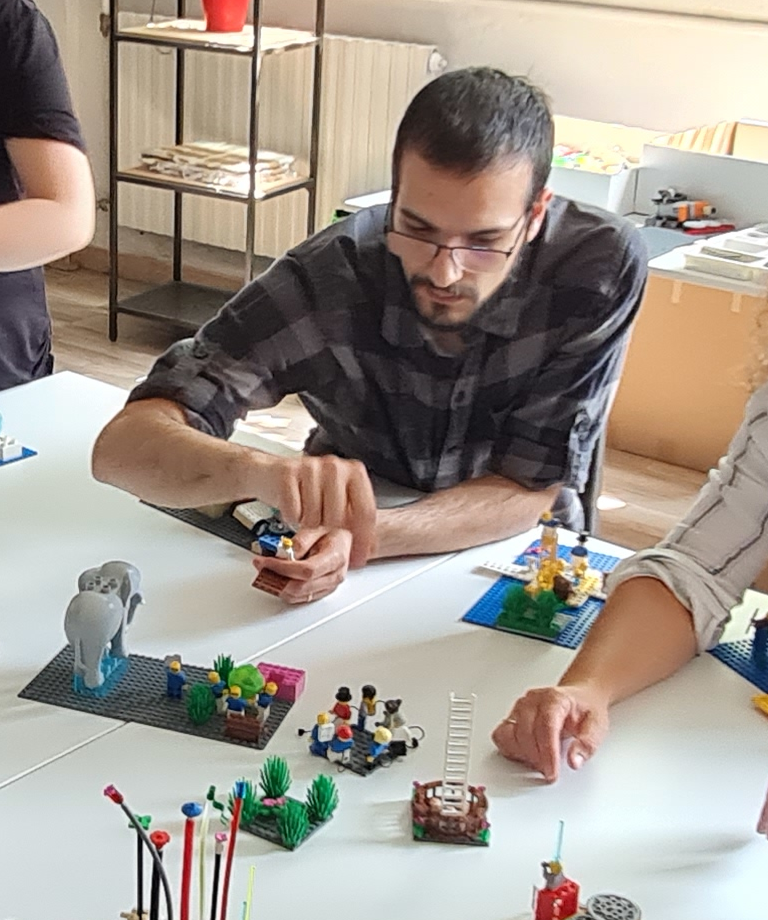
In a few hours, starting from individual models and arriving at a shared one, the group turned abstract concepts into tangible models, in a safe space for dialogue, listening and co-creation. The priorities for the new year emerged very clearly from the participants’ own words and are listed in the box.
The point was not “building with bricks” but building meaning, alignment and shared responsibility.
The priorities that emerged
- Strengthen the safety culture starting from data and feedback
- Lead change by example
- Improve internal communication, involving every function
- Strengthen dialogue with external stakeholders
- Create connections with other European sites
- Remove safety-related barriers and biases
- Standardise communication to make it more effective
Who it is designed for
A workshop of this kind is useful for safety committees, HSE teams, safety managers and operations leaders who want to move from compliance to culture. It works particularly well in technical and operational settings, such as plants, data centres, logistics and maintenance, where safety depends on the daily behaviour of many people.
To explore the scientific basis of the method, read What is LEGO® SERIOUS PLAY® and how a workshop works. For formats and arrangements, see the vision and strategy workshops.
Sources
- Edmondson, A. (1999). Psychological Safety and Learning Behavior in Work Teams. Administrative Science Quarterly.
- Rock, D. (2008). SCARF: a brain-based model for collaborating with and influencing others. NeuroLeadership Journal.
Written by
Samuele Granata
Certified LEGO® SERIOUS PLAY® facilitator and founder of IPPOPO. With over 10 years of experience in IT, he designs team-building workshops and games for companies, events and schools in Milan and Lombardy. About me →
Want to work on safety culture?
We design a tailor-made workshop for your committee or HSE team, in Milan, in Lombardy or at your premises.